Ranthambore Tiger Safari: Adding It to Your Golden Triangle Tour
For a lot of travellers, the Taj Mahal is the dream — and then someone mentions that you can see a wild tiger a few hours from Jaipur, and the trip suddenly grows. Ranthambore is the reason the Golden Triangle so often becomes a “Golden Triangle plus one.” This guide covers what the safari actually involves, when to go, how realistic a sighting is, and how the extension slots into your itinerary, so you can decide whether it belongs on your trip.
What Is Ranthambore, and Why Add It?
Ranthambore National Park lies in southeastern Rajasthan, built around a dramatic tenth-century hilltop fort that was once the hunting ground of the Maharajas of Jaipur. Today it is one of India’s flagship tiger reserves, home to a well-studied population of Bengal tigers along with leopards, sloth bears, deer, crocodiles and more than 300 species of birds. What makes it special for a first-time visitor is the combination: a genuine wildlife experience and a historic fort in one place, reachable without a long detour from the classic route. If you are weighing it against the other add-ons, our guide to Golden Triangle tour extensions compares Ranthambore with Varanasi and Amritsar side by side.
“Our family and friends of 8 from USA took this 11 day tour and we had one of the most exciting and unforgettable experiences in India… We visited Mumbai, Udaipur, Jaipur, Agra and Delhi… This was my second trip to India and I would highly recommend him to anyone visiting India.”
When Can You Go? Ranthambore’s Safari Season
The park runs on a season. The core zones are generally open from 1 October to 30 June and close during the monsoon (July to September), when the tracks become impassable, though some buffer zones may still run limited safaris. Because exact dates and rules change from year to year, confirm the current season when you book rather than relying on an old schedule. The most comfortable months line up neatly with the rest of the Golden Triangle — see our guide to the best time to visit the Golden Triangle for the wider picture. The cooler winter months are easiest for travellers; the hotter pre-monsoon weeks are less comfortable but often bring more frequent sightings as animals gather at water sources.
How Do the Safaris Work?
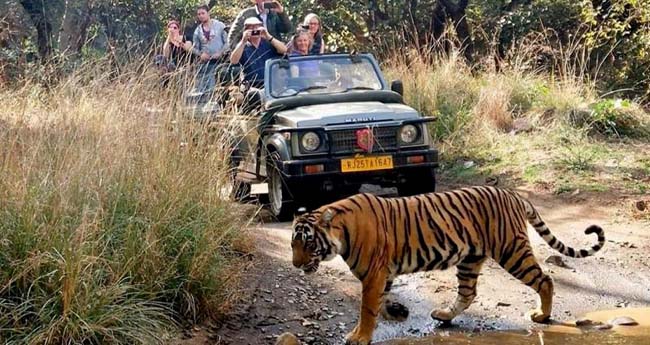
The park is divided into numbered zones, and safaris run in two slots a day, early morning and mid-afternoon, each lasting around three hours. You travel in one of two open vehicles, and the choice shapes the experience. Permits are limited and released in advance, so booking early — especially in peak season — matters.
| Vehicle | Seats | Experience | Best for |
|---|---|---|---|
| Gypsy (open 4×4) | About 6 | More flexible and nimble, quieter, closer to the action | Keen wildlife watchers and photographers |
| Canter (open bus) | About 20 | Shared, higher vantage point, livelier | Budget-conscious travellers and larger groups |
Two safaris across two zones give you the best overall chance, which is why our Golden Triangle tour with Ranthambore builds in a morning and an afternoon drive. If you would rather do Ranthambore as a short standalone add-on, the 2-night, 3-day Ranthambore tour covers the same ground on its own.
Will You Actually See a Tiger?
Here is the honest answer we give every traveller: no safari anywhere can guarantee a sighting, and anyone who promises one is not being straight with you. That said, Ranthambore has some of the best tiger-spotting odds in India, and doing both a morning and afternoon drive improves your chances considerably. Even on a drive without a tiger, the park rewards you — leopards, marsh crocodiles, spotted deer, and an extraordinary range of birdlife, all set against the fort and lakes. Travellers who arrive hoping to simply be in wild tiger country, rather than demanding a guaranteed photo, almost always come away happy.
How Ranthambore Fits Your Golden Triangle Itinerary
Geographically, Ranthambore sits between Jaipur and Agra, so it slots in cleanly without backtracking — our tour visits it after Agra and before Jaipur. Plan on two nights there: the arrival day is a 5 to 6 hour drive from Agra with the evening free to settle in, the next day has both safaris (morning and afternoon), and on the third morning you can add an optional early drive before continuing about 3 hours to Jaipur. Our complete 7-day Golden Triangle tour with Ranthambore (Delhi, Agra, Ranthambore and Jaipur) starts from around $379 per person for the whole trip at the time of writing, with park and camera fees paid locally. If you are still deciding how long your core trip should be before adding anything, our comparison of the Golden Triangle tour options lays out the standard lengths.
Tips for a Great Safari
- Book permits early. Zones and vehicles are limited and sell out in peak season; the earlier you confirm, the better your options.
- Dress in layers. Winter mornings in an open vehicle are cold before the sun warms up, then it heats quickly.
- Bring patience and a camera. Sightings reward those who stay quiet and still; a zoom lens helps.
- Do both drives. One safari is a taste; two, in different zones, give a real chance.
- Let one operator handle permits, vehicle and guide so the pieces line up and you are not chasing paperwork on the day.
Add a Tiger Safari to Your Golden Triangle Trip
Tell us your travel dates and we’ll build a private Golden Triangle itinerary with a Ranthambore safari at the right time of year, permits and all, with a clear all-inclusive quote within 24 hours.
Call US: +1 (929) 335-9645 | India: +91 84302 51784 | WhatsApp | info@perfectagratours.com